


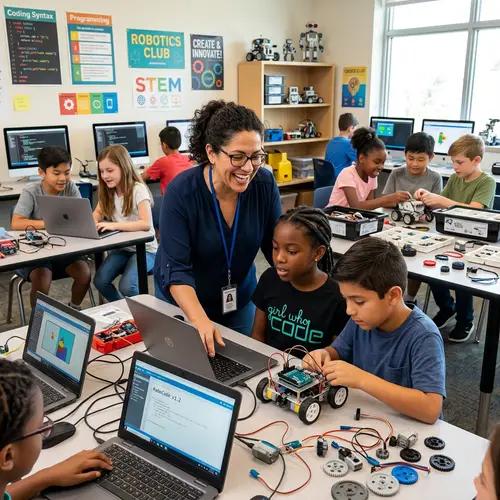
At Futurebytes, we are dedicated to shaping the innovators of tomorrow. With a mission to make learning accessible and engaging, we’re excited to inspire young minds this summer and beyond. See you this summer at Futurebytes—where curiosity meets creativity!
A local STEM center can give children time, tools, and guidance for projects that are difficult to complete during a regular school lesson. Its value comes from the additional learning opportunity it provides. Parents should be able to identify what their child can do there that extends their existing school experience.
Provide access to tools and time
A robotics kit is most useful when a child can build, program, and test it repeatedly. A center may provide equipment that a family would use only occasionally at home. Ask whether the equipment is available throughout the lesson and whether students can return to a project across sessions.
For example, a child might build a delivery robot, then spend a later session making its route more reliable. Continued access allows testing on different surfaces or with different loads. The additional session should deepen the investigation, rather than simply repeat the build.
Create purposeful collaboration
Shared projects can give children practice explaining decisions and incorporating another person's idea. That requires more than putting them at the same table. Ask how students divide tasks, change roles, and resolve different suggestions.
A local design challenge can connect the work to familiar places. Children could model a safer pedestrian crossing or design a container for transporting library books. These are suggested activities, not claims about a particular center's curriculum. Define a constraint, test a solution, and discuss who the design serves.
Connect enrichment with community learning
Museums and science centers can add new questions to an ongoing project. The Exploratorium's Tinkering Studio presents hands-on activities and learning resources that families can explore together. [1] A visit or home activity can complement a class when the child makes a clear connection between the experiences.
When comparing local STEM centers in the Bay Area, ask how progress is shared and whether the program welcomes different starting points. Futurebytes publishes STEM options and locations in Santa Clara, Cupertino, and Los Altos. [2] Choose a local experience that adds something concrete: access to a tool, time to revise an idea, or guidance that helps your child work more independently.
Resources