

At Futurebytes, we are dedicated to shaping the innovators of tomorrow. With a mission to make learning accessible and engaging, we’re excited to inspire young minds this summer and beyond. See you this summer at Futurebytes—where curiosity meets creativity!
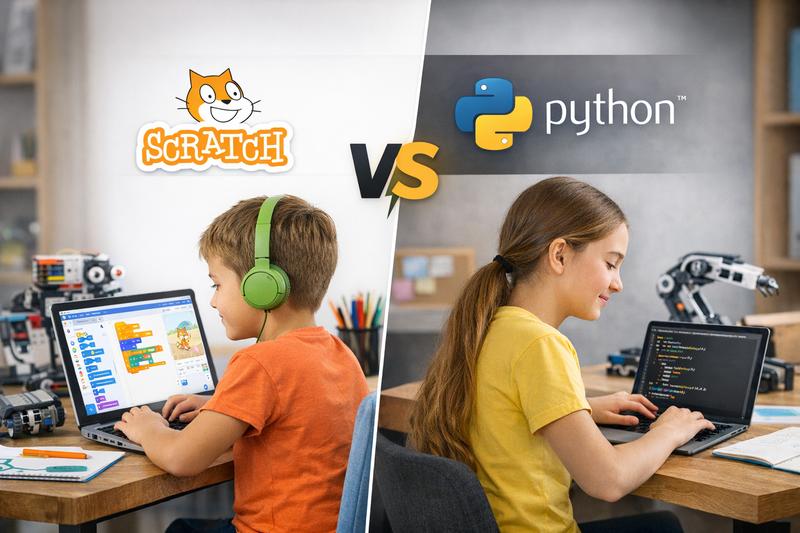
Scratch is often a useful first step for children who want to create visual projects while learning programming ideas. Python can suit a learner who is ready for text instructions and interested in projects that use them. Neither language determines a child's ability; the better starting point depends on the learning goal and current skills.
Use visual coding to focus on behavior
Scratch's blocks let learners organize actions without typing every command. A child can create an animation, add an event, and test a sequence while keeping the result visible. Loops and conditions become useful as the project grows.
For younger children, ScratchJr is a separate introductory tool designed for ages 5–7. [1] Do not assume that the two interfaces have the same features or demands. Ask which tool a class uses and how it fits the learner's reading and navigation skills.
Use Python when text adds a useful next step
Python expresses decisions and repetition with constructs such as if and for. [2] Text coding introduces spelling, punctuation, and indentation requirements, so children need time to interpret errors as well as reason about the program.
A short guessing game can be a manageable first project. It needs input, a stored answer, and a condition to compare values. Begin with a small working version before adding several rules. The benefit of switching is access to a different way of expressing and extending ideas, rather than simply reaching a more impressive label.
Make the transition through a familiar idea
Recreate a small project concept in the new language. Ask what stays the same: the input, the repeated action, or the decision. Then discuss what changes in how those ideas are written. This makes the move easier to understand than beginning with unrelated syntax exercises.
Futurebytes lists Scratch and Python pathways with overlapping age ranges. [3] Silicon Valley families can ask for placement based on project interests and experience. A child may benefit from more complex visual coding before moving to text, or begin text coding with close support. Choose the next step that lets the learner explain and revise their work.
Resources
[1] ScratchJr — Intended age range and design