


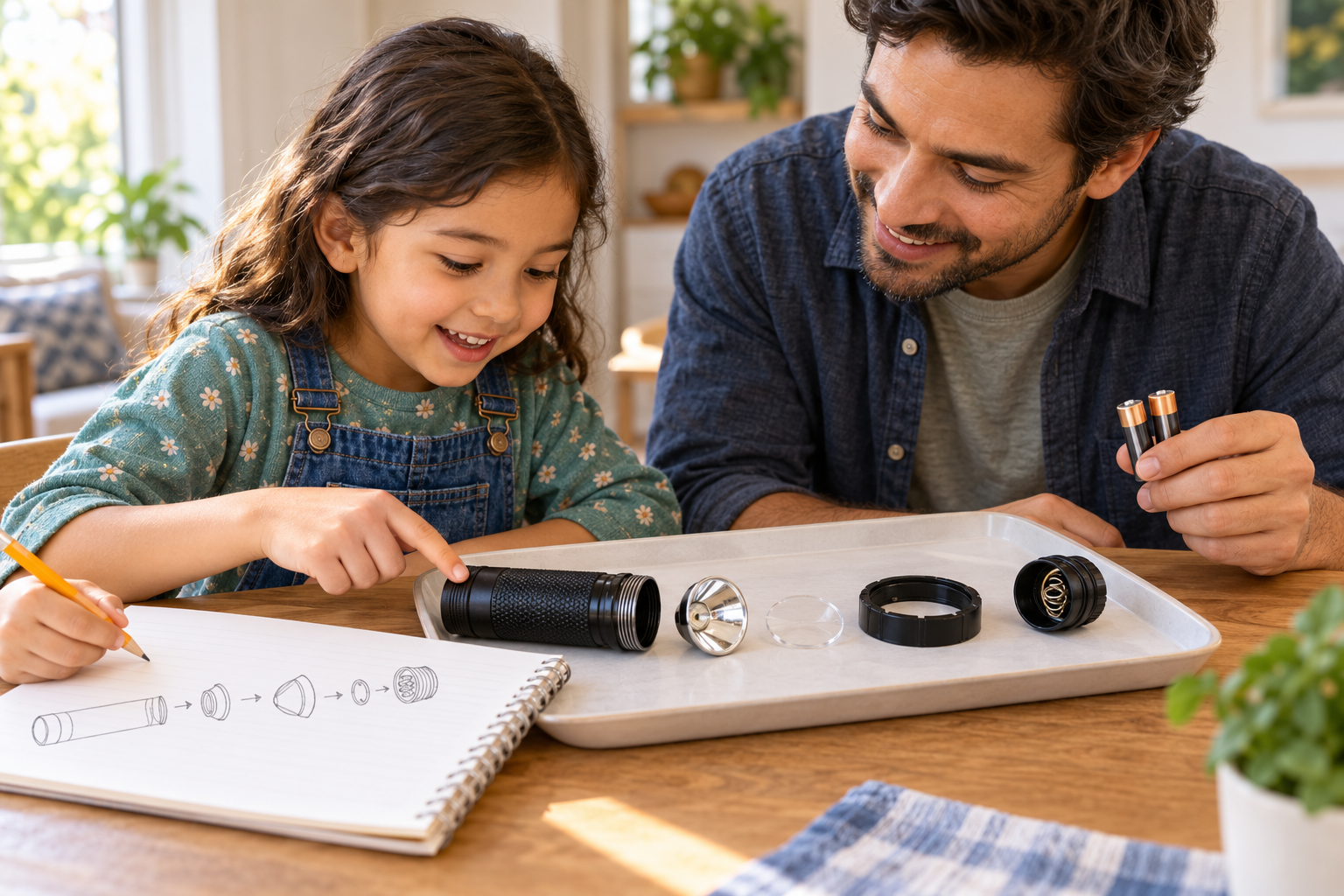
Dismantle safe, unused objects together to see how they function.
Taking an object apart can help children connect its visible behavior with the parts inside. This is an introduction to reverse engineering: investigating an existing design to understand how it works. The goal is a thoughtful part map, with observations and unanswered questions clearly distinguished.
Investigate relationships between the parts
Before removing anything, ask what the object must do. A flashlight needs an energy source, a light source, and a way to control the electrical path. Its casing holds components in position, while a reflector or lens may help direct the light.
The Exploratorium's take-apart guide emphasizes close investigation of familiar objects. [1] At home, choose a simple, intact flashlight designed to open normally, with an adult removing the batteries first. Leave sealed electronics unopened and use only accessible parts approved by the adult. Avoid forcing a connection that resists removal.
Map the parts of a simple flashlight
Materials: A suitable flashlight with its batteries removed by an adult, a tray, paper, a pencil, and a camera if useful. An adult chooses the object, handles tools, and supervises small or delicate parts.
- Document the starting state. Draw the flashlight and mark its switch and opening points. Predict which parts might be visible inside. Keep the batteries away from the activity while you examine the empty casing.
- Open one section at a time. Follow normal removable connections and arrange accessible pieces on the tray in order. Sketch where each piece sits and note what it touches, supports, or protects.
- Trace a relationship. Choose two parts and explain how they work together. Mark uncertain ideas as questions. Reassemble only as appropriate, and have the adult inspect the object before any batteries are returned.
Keep uncertainty visible
A name is useful, but a relationship explains more. Ask how a contact reaches another part or how a cover keeps pieces aligned. Children do not need to identify every component correctly. A careful sketch and a sensible question provide a better starting point than an explanation invented to fill a gap.
Resources