


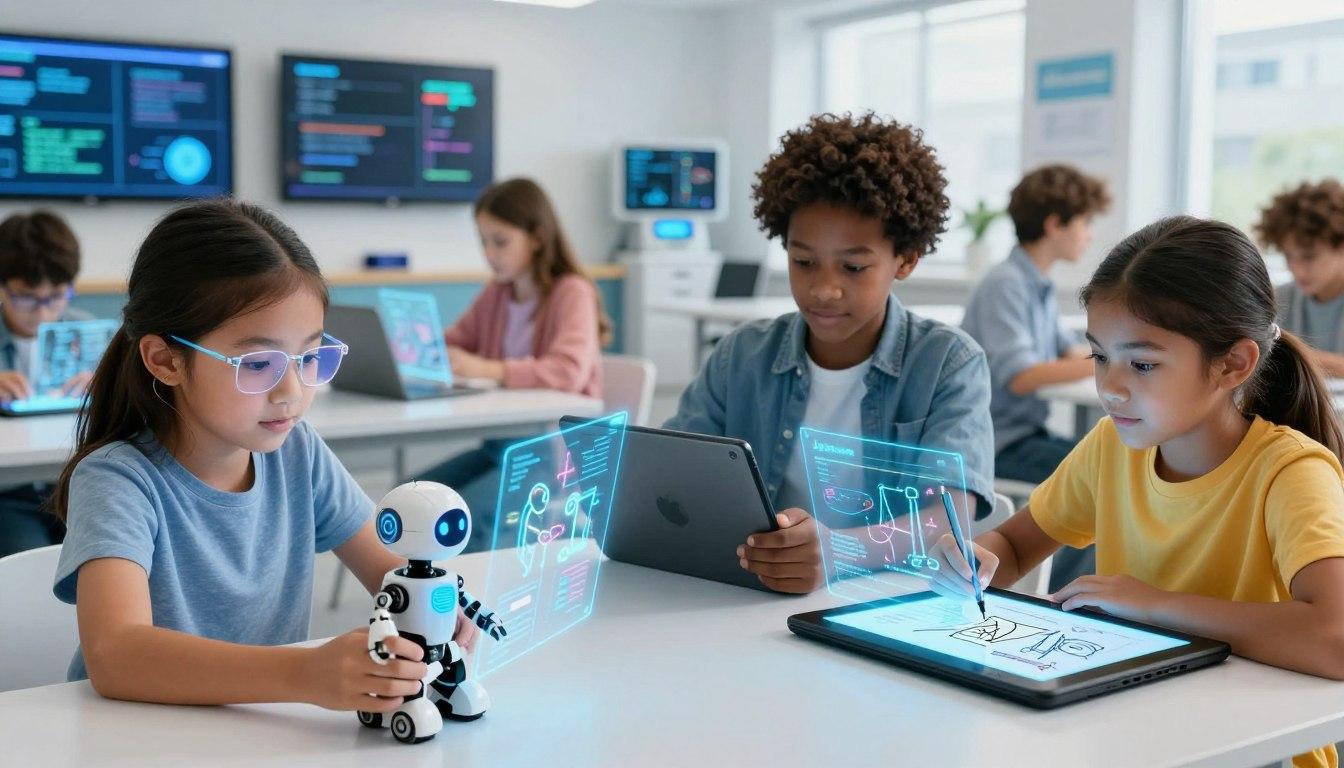
At Futurebytes, we are dedicated to shaping the innovators of tomorrow. With a mission to make learning accessible and engaging, we’re excited to inspire young minds this summer and beyond. See you this summer at Futurebytes—where curiosity meets creativity!
AI education can be appropriate for young children when the activity fits their age, uses suitable tools, and has active adult oversight. Teaching a concept does not require giving a child independent access to a general-purpose chatbot. The learning goal and the safeguards should both be clear before a session begins.
Separate learning about AI from using any AI tool
Sorting fictional picture cards can introduce examples and classification. A teacher-led demonstration can show that a model sometimes predicts incorrectly. These activities teach foundational ideas without asking children to create personal accounts or have open-ended conversations with software.
For any digital tool, check its current minimum age, account requirements, and suitability for the activity. A provider should be able to explain why that particular tool is needed and what alternatives are available.
Ask concrete questions about data and content
Find out whether the activity uses a camera, microphone, uploaded files, or saved chat history. Ask where information is processed, what is retained, and who can view it. Use fictional or non-personal materials whenever the lesson allows. Children's names, school details, private images, and sensitive information should not be part of a casual demonstration.
UNICEF's guidance on AI and children emphasizes safety, privacy, fairness, and accountability. [1] Those principles become practical when a class can explain its settings, supervision, and response to an unsuitable output.
Teach children how to question an output
Explain that generated text can sound confident and still be inaccurate. Practice checking a simple factual claim against a reliable source together. Children should know when to pause and ask an adult, and should not be encouraged to treat an AI system as a person who cares for them.
California's 2026 AI education model policy addresses matters including privacy, disclosure, and parent review rights; it is an adaptable model rather than a mandatory statewide rule. [2] Parents comparing AI classes for kids in California can ask how the provider handles these topics in the actual lesson. Good introductory AI education builds understanding while keeping adults responsible for the learning environment.
Resources
[1] UNICEF — Guidance on AI and children
[2] California Department of Education — 2026 AI model policy announcement