


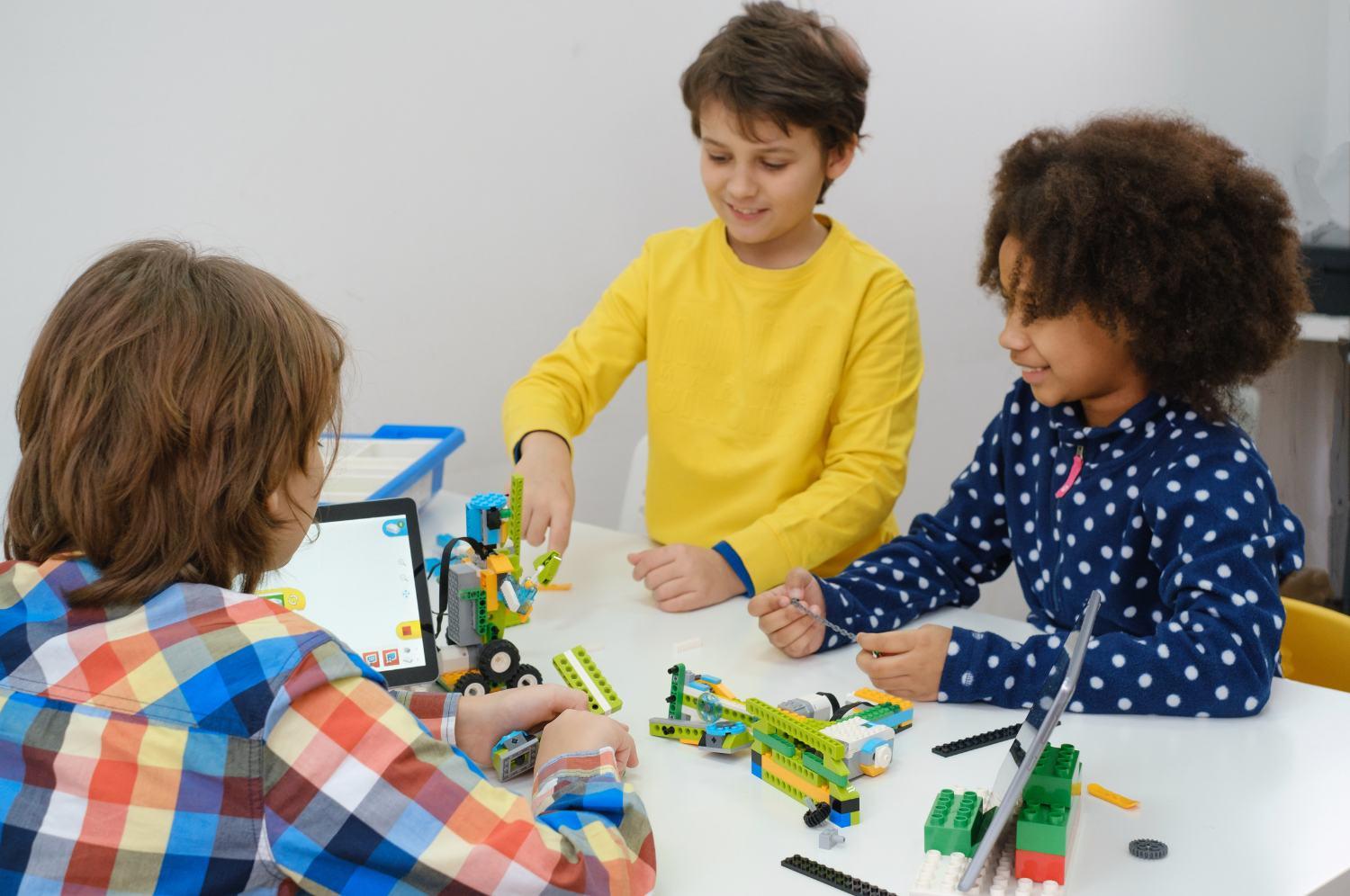
At Futurebytes, we are dedicated to shaping the innovators of tomorrow. With a mission to make learning accessible and engaging, we’re excited to inspire young minds this summer and beyond. See you this summer at Futurebytes—where curiosity meets creativity!
LEGO robotics combines reusable construction parts with programmable hardware. Children can build a mechanism, write instructions, and see how the physical design affects its behavior. The learning outcomes depend on the project and teaching, so parents should ask what a child will understand as well as what they will build.
Connect construction with programming
A moving model can introduce structure, motor control, and ordered instructions. A later challenge might add a loop or use a sensor reading to choose an action. When a model does not behave as expected, students can inspect both the mechanism and the program.
For a sample lifting device, children might compare how different arm lengths affect the load it can raise. They can record observations and change one feature at a time. This gives the construction a technical purpose beyond following assembly steps.
Use age ranges as a starting guide
Futurebytes lists LEGO Creator for ages 5–7, Innovator for ages 8–11, and Master for ages 9–13. Creator and Innovator welcome learners without prior experience, while Master recommends a robotics background. [1] These are the provider's ranges, which may differ from manufacturer grade guidance.
Ask which level fits your child's building experience, reading comfort, and ability to follow a sequence. A first class should allow meaningful participation without requiring the child to manage too many unfamiliar components.
Check the current kit and learning goals
In 2026, LEGO Education retired SPIKE products from sales, while stating that the SPIKE App will be supported until June 30, 2031. [2] Retirement does not immediately make an existing kit unusable. Ask which hardware the class uses, how it maintains that equipment, and whether any competition plans require a different system.
For LEGO robotics classes in Santa Clara, Cupertino, or Los Altos, request a sample task and an explanation of progression. Look for increasing independence in building, programming, and testing. Afterward, ask your child to demonstrate one revision and explain its effect. That provides a clearer picture of learning than the size of the finished model.
Resources
[1] Futurebytes — LEGO robotics levels and age ranges
[2] LEGO Education — SPIKE retirement and support information