


If something catches your eye or you hear something interesting, say it out loud! Involve your child in your curiosity.
Everyday STEM learning can start when an adult says what caught their attention. A changing shadow, a slipping wheel, or a drying puddle offers a question to investigate together. You do not need an immediate answer; begin by noticing carefully and inviting your child's own explanation.
Separate what you saw from what you think
An observation describes something you noticed or measured. An explanation proposes why it happened. If a chair's shadow changes position, the movement is an observation; an account of the Sun's apparent position is an explanation to explore. Keeping the two distinct makes the next question clearer.
For a fixed outdoor object, the changing direction of sunlight affects the shadow. Earth's rotation makes the Sun appear to move across the sky during the day. NASA's sundial resource explains how a shadow's changing position can mark time. [1] Investigate the shadow rather than looking directly at the Sun.
Track a shadow during one afternoon
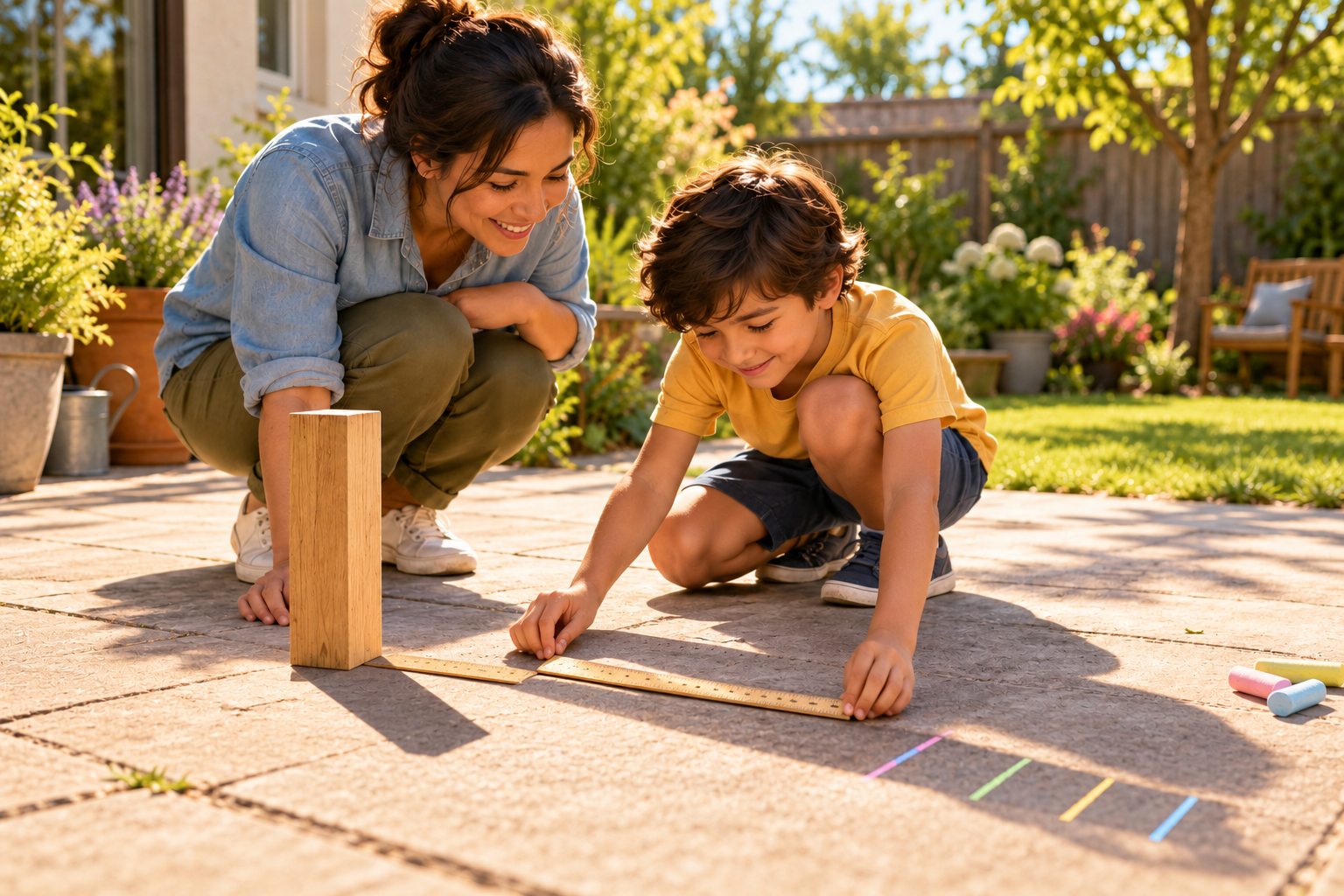
Materials: A fixed outdoor object, chalk or large paper, a pencil, a ruler, and a clock. Choose a level spot where the object can remain in place and the shadow will be visible safely.
- Make a prediction. Identify the object's base and the tip of its shadow. Sketch where the shadow points now, then ask where your child expects it to point at the next observation.
- Record several observations. Mark the shadow's tip three or four times over the afternoon and label each mark with the time. Measure from the same base point, using the same unit each time.
- Compare the marks. Describe changes in direction and length. Note cloud cover or an accidental movement of the object. Decide whether another observation or a diagram would help explain the pattern.
Let one observation suggest another
Ask what the record supports and what it cannot show yet. A single afternoon does not describe every season or location. Your child might compare another day or choose a new phenomenon. The Exploratorium's Science Snacks provide additional investigations when the family wants a starting point. [2]
Resources